Thursday, July 26, 2012

Stocks surge on Draghi comments


 @CNNMoneyInvest July 26, 2012: 11:03 AM ET
U.S. markets
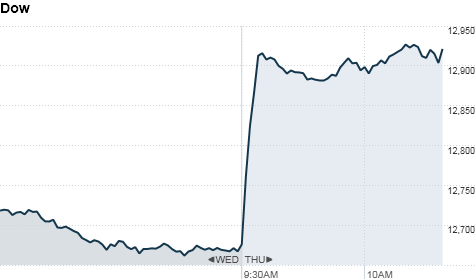
Click the chart for more stock markets data
NEW YORK (CNNMoney) -- U.S. stocks got a boost Thursday after European Central Bank president Mario Draghi said the bank would do whatever it takes to preserve the euro.
The Dow Jones industrial average rose 172 points, or 1.4%, the S&P 500 added 17 points, or 1.3% and the Nasdaq gained 33 points, or 1.2%.
Speaking at an investment conference in London, Draghi's comments suggest the ECB may start buying bonds again in an effort to help bring down skyrocketing borrowing costs.
"His comments were a bit of a game changer because they put the power back in the ECB to buy Spanish and Italian bonds," said Paul Zemsky, chief investment officer for ING Investment Management. "That caused a great turnaround in sentiment."
Analysts also said Draghi's comments signify that another long-term refinancing operation-- the ECB's cheap lending program aimed at preventing a credit crunch-- is back on the table.
Europe's debt crisis remains a significant headwind for global markets, as investors have been growing increasingly convinced that Spain will need a sovereign bailout. The country's borrowing costs remain unsustainably high, with Spain's 10-year yield hovering near 7%, after touching an all-time high of 7.75% Wednesday.
While Draghi was driving the early rally, investors also had a fresh batch of corporate earnings to contend with.
Exxon Mobil's profit surged 49% to $15.9 billion during the second quarter. The massive number -- which would be by far the highest quarterly profit ever for any company -- included a special gain for divestitures. Shares of Exxon (XOMFortune 500) edged higher.
The most anticipated numbers of the day, however, won't come until after the close, when Facebook (FB) reports its first set of quarterly resultsas a public company.
Of the 215 S&P 500 companies that have reported so far, about 67% have beat Wall Street's expectations, according to S&P Capital IQ. Analysts are currently expecting overall S&P 500 second-quarter earnings to decline 0.38%, which would mark the end of a 10-quarter winning streak.
U.S. stocks closed the day in mixed territory Wednesday.
World markets: European stocks jumped after Draghi's comments. Britain's FTSE 100 rose 1.4%, the DAX in Germany added 1.9% and France's CAC 40 surged 3%.
Asian markets ended mixed. The Shanghai Composite lost 0.5%, while the Hang Seng in Hong Kong ticked up 0.1% and Japan's Nikkei rose 0.9%.
Economy: The number of people filing for initial jobless claims fell 35,000 to 353,000 in the latest week, according to the Labor Department. Analysts were expecting a reading of 381,000 unemployment claims.
The Census Bureau reported that durable goods orders rose 1.6% in June, far better than the 0.3% increase economists were expecting.
Mortgage rates reached all-time lows this week for both 30-year and 15-year fixed-rate loans. The average rate for a 30-year mortgage fell to 3.49%, according to the weekly survey by Freddie Mac, and the 15-year dipped to 2.80%. Rates have fallen or matched lows for 13 of the past 14 weeks.
Not all news out of the housing market was positive though. Pending home sales slipped 1.4%, according to the National Association of Realtors. Economists had been expecting growth of 0.9%, according to Briefing.com.
The mixed (but largely still sluggish) economic data has revived the debate over whether the Federal Reserve will take steps soon to stimulate the economy.
Companies: Zynga's (ZNGA) stock plunged 40% early Thursday, a day after the online-gaming company badly missed earnings expectations. Shares of Facebook, which earns roughly 18% of its revenue from users who play Zynga games on its platform, were also down sharply in premarket trading.
Facebook is expected to report quarterly earnings of 12 cents a share on $1.15 billion in revenue later Thursday, according to a survey of analysts by Thomson Reuters.
Shares of Sprint Nextel (SFortune 500) rallied after the wireless carrier reported higher revenues for the second quarter.
Dow component 3M (MMMFortune 500) reported better-than-expected earnings, but the company's revenue fell short of estimates.
Shares of Whole Foods (WFMFortune 500) were up sharply after the organic grocery store chain's earnings surpassed Wall Street's expectations and the company raised its forecast for the year.
Currencies and commodities: The euro popped in response to Draghi's comments, rising more that 1% versus the dollar. The greenback was down versus the British pound, but up against the Japanese yen.
Oil for September delivery rose 81 cents to $89.78 a barrel.
Gold futures for August delivery gained $6.50 to $1,614.60 an ounce.
Bonds: The price on the benchmark 10-year U.S. Treasury fell, pushing the yield up to 1.43% from 1.41% late Wednesday.  To top of page

Monday, July 23, 2012

Saudi Arabia Rocked by Protests


By  (about the author)

Become a Fan Become a Fan  (164 fans)   -- Page 1 of 4 page(s)
Saudi Kingdom Rocked by Protests
Saudi monarchy may be the world's most repressive regime.
by Stephen Lendman
On February 14, 1945, Franklin Roosevelt met with Saudi King Ibn Saud on the USS Quincy. A nearly seven decade relationship followed.
America was guaranteed access to what the State Department called "a stupendous source of strategic power, and one of the greatest material prizes in world history."
It explains much about Washington's obsession with controlling the region. It has around two-thirds of the world's proved oil reserves and major natural gas supplies.

Little wonder America supports what some observers call the world's most repressive regime. State terror is policy. Freedom is prohibited. Authority rests solely with the ruling Al Saud monarch and members of the royal family.
Currently King Abdullah bin Abdul Aziz holds power. Nearly aged 88, he's in poor health. Salman bin Abdul Aziz is crown prince. He also has health problems. A stroke left him bedridden for weeks. They and other family members rule despotically.
Democracy is strictly forbidden. The nation's Constitution affords ordinary citizens and other residents no rights. Women are especially marginalized and denied.
Political parties and national elections are prohibited. Saudi kings appoint a Council of Ministers. It includes a prime minister, first and second deputies, 20 ministers, various advisors, and heads of major autonomous organizations.
The Kingdom has 13 provinces. Ruling monarchs appoint governors. They're either princes or close royal family relatives. In 1993, ministers became subject to four-year term limitations. In 1997, a Consultative Council was expanded from 60 to 90 members.
Media are tightly controlled. Most web sites are blocked. Islam is the Kingdom's state religion. Observing others is prohibited.
Anyone dissenting is subject to arbitrary arrest and detention. Political critics, bloggers, academics, foreign nationals, and humanitarian activists are especially vulnerable.
Saudi journalist Khaled al-Harbi said annual Kingdom revenue exceeds $400 billion. Amounts fluctuate depending on oil prices. At the same time, the average Saudi citizen earns around $400. Al-Harbi says 60% of the population live in poverty.
Official Consultative Assembly of Saudi Arabia (Shura) figures claim 22% of Saudis are impoverished (around three million people). Including migrants and other non-residents, it's believed the true figure approaches al-Harbi's estimate.
A wealth disparity chasm between rich and poor exists. Income depends on how royal family members distribute it. They and privileged elites get most of it. Most Saudis go begging. Migrants and other non-citizens fare worse.
Next Page  1  |  2  |  3  |  4

I was born in 1934, am a retired, progressive small businessman concerned about all the major national and world issues, committed to speak out and write about them.

Thursday, July 12, 2012

More city bankruptcies on California horizon?


San Bernardino declaration raises questions over which city is next

LOS ANGELES (MarketWatch) — Is a high foreclosure rate a possible indicator of municipal bankruptcy? And is there an epidemic looming?
Experts say high foreclosures do seem to be at least a symptom of a possible local financial meltdown after San Bernardino became the third California city in just a few weeks to declare itself bankrupt. But it’s rare that a city tumbles into bankruptcy, and it’s unlikely that high foreclosures alone will cause it.
Foreclosure capitals
Cities with the highest foreclosure rates
RANKCITYRATIO OF TOTAL
HOMES PER FORECLOSURE
1Palm Bay, Fla.170
2Visalia, Calif.174
3 San Bernardino, Calif.179
4Vallejo, Calif.180
5Stockton, Calif.195
6Modesto, Calif.199
7Bakersfield, Calif.205
8Atlanta, Ga.224
9Phoenix, Ariz.245
10Chicago, Ill.252
Source: RealtyTrac
San Bernardino, roughly an hour east of downtown Los Angeles, follows Stockton from the state’s agricultural center — the largest municipal bankruptcy to date — and the Sierra Nevada mountain community of Mammoth Lakes. While the Mammoth Lakes insolvency is due largely to a hefty court judgment against that city, Stockton has a regular presence at or near the top of the most-foreclosed cities list, along with San Bernardino.
Also near the top of that list is Vallejo, in the San Francisco Bay Area. Vallejo declared bankruptcy in 2008 and has been embroiled in a protracted battle with creditors ever since.
“They were hit disproportionately by the housing slowdown,” said Stephen Levy, director of the Center for Continuing Studyof the California Economy. “They were just hammered.”
The connection is easy to make. A high foreclosure rate often is an indicator of lower property values in a region, as it usually is a drag on prices. The lower the property values, the less revenue a city gets in taxes, one of its key sources of income.
Levy says it’s not just lower property values that are hitting city coffers; municipalities throughout the state are having to contend with ever-increasing pension costs for public-safety personnel. But all cities are having to deal with that, and so a region’s property values are the biggest variable that can affect a budget, he says.
Leslie Appleton-Young, chief economist of the California Association of Realtors, says property values in San Bernardino County experienced a 65.6% drop from their peak of $350,290 in August 2006 to their trough of $120,410 in May 2009.
Prices have come up a bit in the region that includes San Bernardino and neighboring Riverside since then, but values are still less than half of what they were at the peak, she said.
“It’s definitely off the bottom, but it’s still well off the prices we saw a couple of years ago,” Appleton-Young said.
Along with the Vallejo, San Bernardino and Stockton regions, other California mainstays on the highest foreclosures list include the inland cities of Modesto, Bakersfield, Merced, Fresno and the state capital of Sacramento.
Also high on that list are a number of cities in states bordering California — including Las Vegas, Reno and Phoenix — as well as a number of towns in another warm-weather state: Florida. The Palm Bay region is at the top of RealtyTrac’s most-foreclosed city list for May, and not far from the top 10 are three other Florida cities: Cape Coral, Tampa and Miami.
Does that mean these cities are vulnerable to bankruptcy? Not so fast, says Jeffrey Esser, executive director of the Government Finance Officers Association in Chicago.
“Bankruptcies are very rare,” Esser said. “Three does not make a trend. But keep an eye on California and see if there are others.”

The U.S. housing bust is over

The U.S. finally has moved beyond attention-grabbing predictions from housing "experts" that housing is bottoming. (Photo: Bloomberg News)
He points out that this most-recent recession has been the strongest since the Great Depression, and thus the hardest hit ever for California cities under the 1978 landmark measure that slashed property taxes in the state, Proposition 13.
“Proposition 13 put severe constraints on revenue,” he said. “Yet the cost of running government continued to go up.”
His sentiments were echoed by Dick Larkin, senior vice president and director of credit analysis for Herbert J. Sims & Co. Larkin said in a note to clients Wednesday that he doesn’t see a wave of insolvency across the country.
“I am worried, however, that this phenomenon may grow in California, which still feels the effects of 1978’s Proposition 13 that dramatically lowered property taxes,” he wrote. “Were that to happen, bond issuers in the state (including the state itself, which plans a $10 billion note issue in a few weeks) may be painted with a ‘scarlet letter’ of ‘B’ for bankruptcy.”
Also troubling to Larkin is the swiftness with which San Bernardino voted for insolvency. When New York and Philadelphia teetered on the brink of bankruptcy in the 1970s and 1980s, respectively, city leaders resisted and instead developed five-year plans to balance their books.
“The city, like most around the country, had been facing flat or declining tax revenue and growing expenditures. However, there had been no public inkling of the magnitude of San Bernardino’s budget problems in 2012; the city’s normal budget process was disrupted with the departures of the city’s manager and assistant manager in April,” he said. 

Russ Britt is the Los Angeles bureau chief for MarketWatch.

San Bernardino bankruptcy timeline


See how this story unfolded, and get a quick accounting of the day's developments.


Read more:http://www.sbsun.com/breakingnews/ci_21056015?source=rss#ixzz20QR1RVe4

Wednesday, July 11, 2012

San Bernardino authorizes bankruptcy filing


The San Bernardino City Council will meet today to discuss the city's $45 million budget deficit and the threat of possible bankruptcy. (Rick Sforza/Staff Photographer)

Storify:Web reactions to the news of San Bernardino's bankruptcy vote|'San Bernardino' trends on Twitter

SAN BERNARDINO -- The City Council voted Tuesday night to authorize abankruptcy filing.
The vote gives City Attorney James F. Penman power to begin proceedings for Chapter 9 bankruptcy, which would free the city of much of itsdebtbut maintain the mayor and council as decision-makers.
Withoutfiling for bankruptcy, the city - which has a deficit of $45 million - would likely be unable to meet its Aug. 15 payroll, according to Penman.
Four council members voted for the authorization, with Councilmen Chas Kelley and Fred Shorett opposing it and Councilman John Valdivia abstaining.
All seven council members, city administrators and many members of the public said the decision was heart-wrenching.
"This is probably the hardest decision this council woman will ever have to make in this chair,' said Councilwoman Wendy McCammack.
"Philosophically, I'm against bankruptcy, but if this is the only way to save the city from long-term debt from which it might never recover ... it's the best choice."
Penman also said at the meeting that for 13 of the last 16 years, the council had been given falsified budget documents. Those documents said the city was in the black when, in fact, it had been deficit spending, he said.
That period covers the tenure of multiple city managers and sets of elected officials, but it predates Acting City Manager Andrea Travis-Miller and Finance Director Jason Simpson, whom he said discovered the discrepancy.
That revelation was part of the reason Valdivia said he was abstaining - he didn't trust any of the information he was given.
"The taxpayers of this city have been duped, hoodwinked and misguided for the past several years," said Valdivia, who added that he was served only since March and should not be held responsible.
In a Twitter post sent during the meeting, he said neither massive city-supervised cuts nor bankruptcy were the right option, but did not say what he would do instead.
"I'm not convinced of either path for our city," he tweeted. "Wish to God there were other viable options. I'm not one to drink the Kool Aid."
In an earlier report to the council, Travis-Miller said the city has faced declining revenues and escalating retirement costs, with employee compensation accounting for about 75 percent of the city's general fund spending.
A bankruptcy filing would reopen negotiations on employee contracts but would not invalidate its pension payments, which Mayor Pat Morris and others have said are the main cause of the city's financial problem.
The filing would probably come in about 30 days, setting off a process of a year to 18 months, according to Travis-Miller.
San Bernardino would be the third California city tofile for bankruptcythis year, following Stockton and Mammoth Lakes. In 2008, Vallejo filed for bankruptcy.
Reach Ryanvia email, or call him at 909-386-3916.


Read more:http://www.sbsun.com/ci_21044462/city-discuss-potential-bankruptcy-budget-options-today?nstrack=sid:5579295|met:300|cat:0|order:5#ixzz20NX06v8D

San Bernardino leaders couldn't see fiscal woes


San Bernardino appears poised to become the third California city to file for bankruptcy protection so far this year.
Citing the ongoing economic downturn, lack of recovery in the housing market and state funding take-aways, the City Council voted Tuesday to file Chapter 9. Without filing for bankruptcy, officials said, the city probably could not meet its Aug. 15 payroll.
In recent weeks, the cities of Stockton and Mammoth Lakes made similar moves.
If San Bernardino's decision seems sudden, however, it's really not.
The city has been struggling to reinvent itself for years and has been particularly hard hit by the recession. At the same time, city leaders have spent too much time politicking and feuding and obviously not enough time scrutinizing the city's finances.
Were they surprised when Acting City Manager Andrea Travis-Miller and Finance Director Jason Simpson reported to the council only two weeks ago that San Bernardino has a $45 million budget deficit?
City Attorney James Penman said at the meeting Tuesday that for 13 of the past 16 years, the council had been given falsified budget documents - showing the city in the black when it was actually in the red. Did they just discover this?
That's an amazing statement, especially since that period spanned several city managers and interim city managers and finance directors, not to mention elected officials. A serial conspiracy to lie about the budget to the

Advertisement

mayor and council over 16 years seems far-fetched, so we look forward to learning how Penman came to that conclusion.Penman, incidentally, is the only elected official other than the city treasurer to have served through those 16 years, and has consistently campaigned on his ability to hold the mayor's and council's feet to the fire.
The city attorney is also a major player in the circus that masquerades as City Council meetings. Penman and Councilwoman Wendy McCammack on one side, and Mayor Patrick Morris and his council supporters on the other, appear to spend more time baiting and reacting to each other than they do overseeing the city.
Observers of the city's meetings might find it small surprise that this crew hasn't performed its fiduciary oversight. Politics and personality trump all other concerns.
Still the city has made significant cuts in recent years:
San Bernardino has laid off 20 percent of its work force - more than 250 employees - and has wrung $10 million in concessions from employee unions over four years. Morris points to the $30 million hit to the city from the state's abolition of redevelopment, but says employee costs are still the big thing that must be addressed.
Retirement spending has gone from 9 percent of the general fund in 2006-7 to 13 percent of the general fund in 2011-12 and is expected to account for 15 percent of general fund spending by 2015-16.
McCammack blames overspending by Morris and his council majority on projects like the rapid-transit bus line, the Regal Theater and Operation Phoenix. One has to wonder also about the fiscal effects on the city of woebegone San Bernardino International Airport, which is under federal investigation.
We have little respect for Councilman John Valdivia's abstention from the bankruptcy vote. He was not elected to duck the biggest issue the city faces. In fact, he was elected with safety union backing, ousting an incumbent who was the city's main advocate of pension reform. If escalating pension costs are among the city's fiscal problems, sitting on the sidelines does no good.
City employees will be hurt by civic bankruptcy, and so will every resident and business in San Bernardino. That's the real tragedy here.


Read more:http://www.sbsun.com/ci_21054247/san-bernardino-leaders-couldnt-see-fiscal-woes?source=most_emailed#ixzz20NAAFxXc

Tuesday, July 10, 2012

San Bernardino votes to file for bankruptcy protection


Bernardino-blog
The San Bernardino City Council votes to file for bankruptcy. Facing a $45-million budget shortfall and the prospect of not being able to pay city workers, the panel Tuesday voted to file municipal bankruptcy, the third California city to do so in recent weeks.
The vote came shortly after the interim city manager recommended seeking bankruptcy protection, saying the city may not be able to make payroll over the next three months. "We have an immediate cash flow issue," Andrea Miller told the mayor and seven-member council.
The dire fiscal situation remains even after the city negotiated $10 million in concessions from employees and slashed the workforce by 20% over the last four years.
If San Bernardino declares bankruptcy, it would be the third California city to do so in recent weeks, joining Stockton and Mammoth Lakes. The council called special back-to-back budget meetings Tuesday and Wednesday, which are expected to attract a packed house at City Hall.
ALSO:
-- Phil Willon in San Bernardino
Photo: San Bernardino would be the third California city to seek bankruptcy protection in recent weeks. Credit: Glenn Koenig / Los Angeles Times

Mammoth Lakes files for bankruptcy
