Tuesday, July 9, 2013

Global Corruption: Where bribery flourishes (and where it doesn't)

from latimes


  • print
Global Corruption Barometer 2013
A map produced by Transparency International shows the percentage of people surveyed in each of 107 countries who paid a bribe to one of eight services in the last 12 months. (Transparency International /July 9, 2013)
In Zimbabwe, women delivering babies at a hospital were reportedly charged $5 for every scream. In Bangladesh, corrupt building practices were believed to have contributed to the collapse of a garment factory complex that killed more than 1,000 people.
These are some of the ways that corruption affects people around the world, according to a new report from Transparency International.  The Berlin-based watchdog’sGlobal Corruption Barometer 2013 makes for sober reading.
More than 1 in 4 people reported paying a bribe when using public services and institutions in the previous 12 months, according to a survey conducted in more than 100 countries.
The figures were highest in the African nations of Liberia and Sierra Leone, where 75% and 84% of those surveyed paid a bribe, respectively, the report says. That is compared with just 1% in Australia, Denmark, Finland and Japan. In the United States, 7% of those surveyed reported paying a bribe.
“Bribe paying levels remain very high worldwide,”  Transparency International Chair Huguette Labelle said in a statement Tuesday.  “But people believe they have the powerto stop corruption, and the number of those willing to combat the abuse of power, secret dealings and bribery is significant.”
More than 114,000 people in 107 countries were surveyed between September 2012 and March 2013 for the report.
Nearly 9 out of 10 said they would act against corruption, and two-thirds of those who were asked to pay bribes said they had refused at least once, the report says.
Too often, however, the institutions responsible for fighting corruption are themselves viewed as corrupt, the report says. Police were viewed as the most corrupt institution in 36 of the countries surveyed and the judiciary in 20 countries.
Trumping them all were political parties, which were viewed as the most corrupt institutions in 51 countries, including the United States.

World economy stuck in neutral: IMF

from cnn


@MarkThompsonCNN July 9, 2013: 10:37 AM ET
chart imf
LONDON (CNNMoney)

The International Monetary Fund cut its forecast for world economic growth for a third time this year due to slowing emerging markets and a prolonged recession in the eurozone.

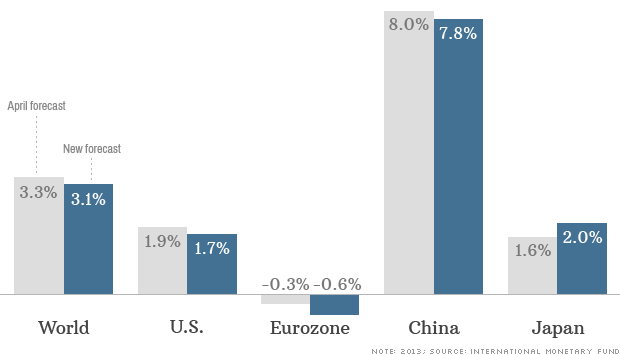
In an update to its World Economic Outlook, the IMF said Tuesday that it now expects world output to expand by just 3.1% in 2013, down from 3.3% in April. In January, it was forecasting growth of 3.5%.
The revision means the global economy will have failed to pick up pace over the past two years, although the IMF expects a slight acceleration in growth in 2014 to 3.8%.
Since its last global report in April, the IMF has cut its 2013 growth forecasts for the U.S. and China to 1.7% and 7.8%, respectively. And it now expects the eurozone economy -- mired in its longest recession -- to shrink by 0.6% this year, double the rate of contraction forecast in April.
"While old risks remain, new risks have emerged, including the possibility of a longer growth slowdown in emerging market economies," the IMF said, pointing to slowing credit growth and the possibility that capital will return to the U.S. if the Federal Reserve begins to unwind its policy of buying government bonds to keepinterest rates low.
Recent data from China point to a slowdown in its huge manufacturing sector. And attempts by Chinese policymakers to control runaway real estate markets and avoid acredit bubble have unnerved investors in recent weeks and prompted private sector economists to cut their growth forecasts.
The knock-on effect of slower growth in China is already being felt in other commodity-richemerging markets such as Brazil and South Africa. The IMF cuts its forecast for Brazil to 2.5% from 3% and for South Africa to 2% from 2.8%.
Three major economies should buck the trend, however. Japan, basking in the earlysuccess of Abenomics, could see growth of 2% this year, up from a previous forecast of 1.6%. The IMF has also revised up its 2013 forecasts for the U.K and Canada by 0.3% and 0.2%, respectively.
Business sentiment surveys have begun to suggest the rate of decline in the eurozone is slowing but there's still considerable risk to official forecasts of a return to growth later this year.
The European Central Bank said last week it had a downward bias on interest rates and would maintain that stance "for an extended period," given the challenge the region faces in balancing the goal of further reducing government borrowing with the need to stimulate activity to bring down record levels of unemployment.
Germany, the region's biggest economy, provided a stark reminder Monday of the mountain Europe still has to climb. Its exports to the eurozone fell by 9.6% in May compared with the same month last year, and by 1.6% to countries outside Europe.
In a separate report on the eurozone last week, the IMF warned that fragmented financial markets and the high cost of borrowing in peripheral nations was depressing activity across the region.
It called on European leaders to do more to repair bank balance sheetscomplete work on a banking union, provide further support to the economy via easy monetary policy and show more flexibility on austerity while preserving medium-term debt reduction goals. To top of page


Saturday, July 6, 2013

Law requires Obama administration to cut off Egyptian aid

from dailycaller


The $1.5 billion in U.S. foreign aid slated for Egypt next year is in jeopardy after the Egyptian army deposed democratically elected President Mohamed Morsi on Wednesday.
Section 508 of the decades-old Foreign Assistance Act stipulates that “none of the funds appropriated or otherwise made available pursuant to this Act shall be obligated or expended to finance directly any assistance to any country whose duly elected head of government is deposed by a military coup or decree.”
A clause in the 2011 omnibus bill strengthens the provision, excluding from American aid any nation experiencing a “coup d’etat or decree in which the military plays a decisive role.”

Although events in Egypt appear to conform perfectly to these criteria, it’s unclear whether the Obama administration will cut off revenue to the strategically important nation anytime soon.
“Given today’s developments, I have directed the relevant departments and agencies to review the implications under U.S. law for our assistance to the Government of Egypt,” President Barack Obama said in a statement released Wednesday evening.
But the president also refused to call the takeover a coup, indicating his administration’s wariness to label events in Egypt before deciding how to proceed.
Time reports that the $1.3 billion marked for the Egyptian military in 2014 is around 20 percent of that organization’s total budget. Without that money, the army may be unable to keep the peace should an extended confrontation develop between Morsi’s supporters and opposition activists.
“The Egyptian military has long been a key partner of the United States and a stabilizing force in the region, and is perhaps the only trusted national institution in Egypt today,” House Majority Leader Eric Cantor said in a statement Wednesday.

The ranking Republican on the Senate Foreign Relations Committee echoed that sentiment.
“In determining the future of U.S. assistance, the administration should look at the regional picture with our national security interests in mind,” Tennessee Sen. Bob Corker said in a Wednesday announcement. “Our long-standing cooperation with Egypt, which is essential for stability in the region, should remain a priority.”
Their comments indicate that the administration would face little protest from congressional Republicans if they decide to ignore or circumvent the law on foreign assistance.
But politicians from the president’s own party may be less forgiving.
“Our law is clear: U.S. aid is cut off when a democratically elected government is deposed by military coup or decree,” said Vermont Democratic Sen. Patrick Leahy, chair of the budget committee which oversees foreign aid.
John Bellinger, a senior fellow at the Council on Foreign Relations, pointed out in his blog on Thursday that unlike many parts of the Foreign Assistance Act, the provision restricting foreign aid “does not include Presidential waiver authority.”
Sponsored From Around the Web


Read more: http://dailycaller.com/2013/07/05/law-requires-obama-administration-to-cut-off-egyptian-aid/#ixzz2YKaXJUrS

Tuesday, July 2, 2013

Egypt Q&A: Why is the country once again in turmoil?

from ctvnews


Tahrir Square rally
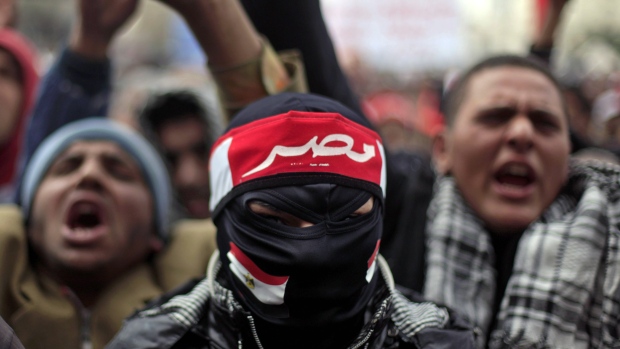
An Egyptian masked protester wears a head banner with Arabic writing that reads "Egypt", during a rally in Tahrir Square, Cairo, Egypt, Friday, Feb. 1, 2013. (AP Photo / Khalil Hamra)
CTVNews.ca Staff
Published Tuesday, July 2, 2013 1:53PM EDT 
Huge demonstrations are underway once again in Cairo and across Egypt, as the country slips again into political crisis. Here is a look at the issues that are driving the protests and what could happen next.
Why are Egyptians protesting again?
Since the end of former president Hosni Mubarak’s 30-year rule during the Arab Spring uprisings more than two years ago, Egypt has remained in turmoil.
Much of the country’s anger has centred on Egypt’s dismal economy, which has been in crisis as the country has watched its vital tourism industry dry up over the last two years. Power outages have become frequent, and food prices have been soaring, even as unemploymenthas grown.
At the same time, many liberals have accused president Mohammed Morsi of betraying the revolution by trying to “Islamize” their relatively moderate country.
They have looked suspiciously upon the appointment to cabinet of members of the powerful Muslim Brotherhood, the Islamist group that was once suppressed under the Mubarak regime but that has since become Egypt's strongest political force.
Discontent with Morsi’s rule turned to anger in November 2012, when the president unilaterally issued a constitutional declaration giving himself extensive powers, protecting his decisions from judicial review and barring the courts from dissolving the assembly and houses of parliament. That move sparked days of protests, and led to the first calls for Morsi to leave.
The anger has since been aggravated by further appointments of Muslim Brotherhood members to key posts -- appointments that liberals say were based not on competence but on loyalty to Morsi.
What has happened in recent days?
On Sunday -- the first anniversary of Morsi’s inauguration -- millions of Egyptians took to the streets in Cairo and other cities, calling for Morsi to step down. The demonstrations have been the largest in the country since Egyptians rose up against Mubarak in January 2011 and have remained largely peaceful, given their size. But at least 16 people have died and hundreds more were injured in sporadic clashes, most of them in Cairo.
Then on Monday, Egypt's powerful military issued a "last-chance" ultimatum over state TV, giving Morsi 48 hours to meet the demands of the protesters, or watch the army intervene and impose its own plan for the country.
Two of Morsi's spokesmen and his foreign minister have since resigned.
Who are the protesters?
The protests have not been led by any one political party, but by the Tamarod, which means “rebellion” in English. The grassroots movement was established in early May by young Egyptians, including members of the Egyptian Movement for Change, also known as Kefaya, which pushed for political reform under former president Mubarak in 2004 and 2005.
What do the protesters want?
The key demand has been their call for an early presidential election. They say they have collected more than 22 million signatures both online and in paper demanding the president resign.
If Morsi steps down, the Tamarod wants to see head of the Supreme Constitutional Court become interim president. They then want a new constitution drafted to replace the one created last year, and new presidential elections held within six months.
What are Morsi's options?
Morsi's office has issued a defiant statement insisting that a "modern democratic state" was one of the main achievements of the anti-Mubarak revolution, and that Egypt should not allow itself to take a step backward.
But with the resignation of several key ministers in the last week, the liberal opposition declining to work with Morsi, and Egyptian police refusing even to protect the offices of the Muslim Brotherhood, Morsi’s current government likely can no longer function as is, observers say.
He has the option of reshuffling his cabinet, holding a referendum on completing his term, or calling an early presidential election, as the protesters are demanding.If Morsi chooses to step aside, his prime minister, Hesham Qandil, could take over his role until a new president is elected.
With reports from The Associated Press


Read more: http://www.ctvnews.ca/world/egypt-q-a-why-is-the-country-once-again-in-turmoil-1.1350228#ixzz2XuvyU2BY