Thursday, June 21, 2012

Society Pages Blog

So where’s the correction?

May 16, 2012
After a stunning $2 billion loss in European trading by JPMorgan Chase last week, the FBI in the U.S. has opened a preliminary review of the debacle.
As punishment, Ina Drew, the Chief Investment Officer whose London office orchestrated the trades, was promptly kicked to the curb. That lowers the ratio of male to female traders on the London Stock Exchange from a high of 260 male traders to 4 female to 260 to 3.
CEO Jamie Dimen remains. He’s been doing the rounds on the Sunday chat shows saying his company was “sloppy” and “stupid.”  Meanwhile he’s been unapologetically leading the charge to prevent the caps on market speculation recommended by Obama.
And, so, for the third time in three years I’m reprinting a post I wrote on Wall Street culture shortly after the first U.S.-led economic crash.
Like I said before, if you think our elected leaders are in control of the economy and our futures. Think again. The stockjockeys are.
Being an average citizen sure feels powerless.

First published in March 2010
It’s been 18 months since the economy tanked, and the average investor who hung on during the worst stretch of stock market bucking and kicking has already regained most of what they lost. For many, then, it’s business as usual.
But if market corrections were inevitable, social ones are still pending, but possible, according to one of journalism’s best financial reporters.
I’m talking about Michael Lewis of Vanity Fair. He continues to doggedly turn over the rubble of 2008, assessing every detail with a coroner’s gimlet eye so he can come back and tell us exactly how traders back then were measuring risk and following abstruse formulas cooked up by their bosses to increase profits.
Still, after reading Lewis’ most recent VF features I couldn’t summarize his technical explanation of the machinations of subprime-mortgage bonds if my life depended on it (I’m referring to his articles,”Greed Never Left” and “Betting on the Blind Side,” both in the April 2010 issue). But that’s not because Lewis’s prose style isn’t clear or engaging. I have troubles remembering blow-by-blow descriptions of how people cheat (maybe because my instincts run counter to this). But I pounce on explanations that take a stab at why they do.
michael-lewis
Lewis, a former Wall Street broker turned chronicler, is part of a growing contingent of journalists (Nicholas Kristof of The New York Times is another) whose strict objectivity has taken a back seat to their impassioned analysis of human nature. “You have to be careful how you incentivize people,” Lewis told Steve Kroft last Sunday on 60 Minutes in a discussion about traders and money managers. “If you pay someone not to see the truth, they won’t see it.”
Both Lewis and Kristof are gathering their data and making their astute observations from the epicenter of the best behavioral test labs imaginable: extreme greed in Manhattan and extreme poverty in the developing world. Kristoff , for example, cites studies that have found when “women hold assets or gain incomes [in the developing world], family money is more likely to be spent on nutrition, medicine and housing, and consequently children are healthier.” But when men hold the money, and this is “the dirty little secret of global poverty,” he says, more often they spend it “on a combination of alcohol, prostitution, candy, sugary drinks and lavish feasts,” not on their families.
Filmmaker Oliver Stone, the son of an honest Wall Street broker, is another surprise addition to this group of creatives pushing to see human nature’s better side come to the fore. Despite what most people think, the notoriously difficult Stone never intended to make Gordon Gekko, Michael Douglas’s character in his 1987 blockbuster Wall Street, a hero, but that’s exactly what he became in the minds of so many guys working in finance, he tells Lewis in VF’s April issue. Douglas still gets Wall Street hot shots coming up to him and saying, “’Man, I want to tell you, you are the single biggest reason I got into the business. I watched Wall Street, and I wanted to be Gordon Gekko.’”

Shia+Michael+film+park+x7KpySL-G_8l
Stone shakes his head at this. So does screenwriter Stanley Weiser. Both feel like their cautionary tale was hijacked by a misinterpretation that helped create the culture that led to 2008. Now Stone wants to use the sequel, Wall Street: Money Never Sleeps, which hits theatres in September, to correct that initial misreading. By bringing back Douglas as Gordon Gekko and setting the sequel in 2008, Stone wants to show, in his words, ”the collapse of capitalism and the collapse of our society.”“Our way of life is going to change,” he tells Lewis. I couldn’t tell if that was his hope or a prediction.
Change only happens, though, when new points of view are folded into the mix. And while women aren’t new (!), hearing their voices in the halls of power is still unique. No one knew this better than America’s First Lady Abigail Adams. In 1776, just as legislators were gathering in Philadelphia to design a new independent American government, Adams, in her flowing cursive, famously instructed her husband, U.S. President John Adams, to “Remember the ladies.” Well, they forgot. But Abigail kept pushing anyway. “Don’t put such unlimited power in the hands of the husbands,” she continued. “Remember all men would be tyrants if they could.”

abigailschmannadams
The more Abigail wrote, the more philosophical she became. “[John], you tell me of degrees of perfection to which Humane Nature is capable of arriving, and I believe it, but at the same time, lament that our admiration should arise from the scarcity of the instances.” You’d think she was referring to a room full of slick-haired stock jockeys high-fiving each other over a run of questionable gains (they were in powdered wigs and buckled shoes — all the same without their clothes).
Due to unfinished business, the ghost of Abigail Adams is still with us, touching down all over the globe and pushing for change.  I’m convinced her spirit crashed the World Economic Forum in Davos Switzerland last winter. All of a sudden, and quite out of character, the participants (most of them, almost dead white men, except for the sprightly Rev. Desmond Tutu) began asking, “Would this economic crisis have happened if Lehman Brothers had been Lehman Sisters?”
Journalists like Michael Lewis, Nicholas Kristof and Charlie Rose (proud feminists, all), gloved that spectacular sound bite and refused to drop it, posing the question not once but again and again and again until what started as a clever quip turned into an outright challenge from the media aimed at a corrupt financial system.
The financial culture …is a pool of sharks, and women just despise [it],” Kristin Petursdottir told Lewis in his 2009 VF feature on the collapse of Iceland’s economy. In 2005 Petursdottir was Iceland’s lone woman in a senior banking position (she was deputy CEO for Kaupthing in London). But she has since quit and now runs a financial services business staffed entirely by women. “People thought I was crazy [to quit],” she says, but Petursdottir was determined to bring “more feminine values to the world of finance.” Science agrees, saying our financial wellbeing depends on it.
To my male readers, I say at this juncture, stay with me on this. We all want a better world. And if that doesn’t grab you because you secretly like the way things are, then I’m guessing you lost money in the crisis, so listen up!
The latest data from Vanguard, the American mutual fund company, reports that during the financial crisis of 2008/09, more men than women sold their shares at stock market lows. “There’s been a lot of academic research suggesting that men think they know what they’re doing, even when they really don’t,” said John Ameriks, head of Vanguard Investment Counseling and Research, in a New York Times article published last Sunday. The article by Jeff Sommer, called “How Men’s Overconfidence Hurts Them as Investors,” also said, “Gender differences appear to extend to other financial behavior. For example, women who are C.E.O.’s and company directors tend to pay lower premiums in corporate takeovers, saving their shareholders a bundle.”
It makes me wonder what would happen if we reversed the male/female ratio on the floor of the stock exchanges? In 2008, for example, the London Stock Exchange consisted of 260 male traders and 4 females. After a period of, say, five years, what patterns would emerge in the economy if this were reversed?
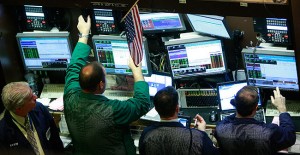
What’s more, a growing number of researchers in the last two years have been combining neuroscience and economics (neuroeconomics) to understand the roles testosterone and cortisone play in financial risk taking. In the spring of 2008, a research team at the University of Cambridge studied the spit of a group of London traders over 8 days and confirmed what most of us have always suspected: that testosterone rises in an economic bubble and these raised levels lead to irrational choices.
20081107_nyse1_33
The researchers said that the relationship between market events and the male endocrine system was like a relay race. “When traders experienced acutely raised testosterone [levels] … they made higher profits, perhaps because testosterone has been found, in both animal and human studies, to increase search persistence, appetite for risk and fearlessness in the face of novelty.”
YE US Open Golf
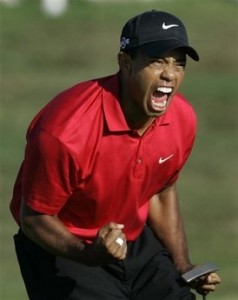
Like the “winner effect” in professional athletes, testosterone rises in the winning athlete (Tiger), but falls in the losing one. “This androgenic priming of the winner,” say researchers, “can increase confidence and risk-taking and improve chances of winning yet again, leading to a positive feedback loop.”
But, the Cambridge team also found that “if testosterone continued to rise or became chronically elevated, it could begin to have the opposite effect on profit and loss, exaggerating the market’s upward movement.” Similarly, in volatile times, a rise in cortisol levels in these guys — often by as much as 500 % by day’s end — exaggerated a downward swing (resulting in massive sell-offs). “These steroid feedback loops may help explain why [male traders] caught up in bubbles and crashes often find it difficult to make rational choices.”
The question remains, what can female investors, golf wives and rational male investors do to diffuse the extreme male behavior of a select group that, clearly, is capable of  running us all into the ground?
Do you put each trader in a single enclosed office space away from his buddies? I say that because researchers at theUniversity of California published a study in March 2008 that found that men in group situations, like trading floors, are more likely to engage in risky decision making because they get caught up in issues of relative social status and dominance.
Or, do you pay female traders big bucks (big bucks because most hate working in hyper-competitive environments) to infiltrate this boys club and diffuse the cloud of testosterone hanging over the floor? A study from 2000 published in The Journal of Economic Theory found there was “a strong consensus that diverse groups perform better at problem solving,” than homogeneous ones. And, anecdotally, we all know that the presence of women is often the only way to diffuse extreme male behaviour.
Then again,  putting more women on the trading floor would probably just spike testosterone levels even higher.

wittenberg1
So here’s my solution: Spray estrogen in the air at regular intervals on the trading floor, play classical music, and enlist the mothers. Have the moms make daily desk-side visits with their boys so they can stroke their hair and feed them homemade lunches. “Now, Dear, stop drinking that Red Bull and eat this casserole. And why are you  sniffing so much? Do you have a cold?”
We have to do something to calm them down and protect our assets.

Wednesday, June 20, 2012

Asian shares struggle, commodities down as Fed disappoints


Related Topics

Tokyo Stock Exchange employees monitor the market at the bourse in Tokyo June 18, 2012. REUTERS/Yuriko Nakao
SINGAPORE | Wed Jun 20, 2012 11:18pm EDT
(Reuters) - Asian stocks outside Japan slipped and commodities fell broadly on Thursday after the Federal Reserve ramped up monetary stimulus by expanding "Operation Twist" but disappointed some investors who had been hoping for more aggressive measures.
The U.S. central bank, as expected, extended its program of selling short-term securities and buying longer-dated ones, a move aimed at driving down borrowing costs, but did not signal a third round of quantitative easing.
MSCI's broadest index of Asia Pacific shares outside Japan .MIAPJ0000PUS fell 0.8 percent, Brent crude oil slid to an 18-month low and the Australian dollar, sensitive to commodities demand, also lost ground.
Sentiment was not improved by closely watched data from China, where HSBC's flash purchasing managers index showed the factory sector contracted for an eighth straight month in June, with export orders and prices at their weakest since early 2009.
Japan's Nikkei share average .N225 bucked the trend, rising 1 percent after the Fed's decision to restrict itself to extending Operation Twist to the end of the year weakened the yen against the dollar, which should help Japanese exporters.
"The positive impact of a weaker yen should outweigh the disappointment about the U.S.'s economic outlook and the lack of more powerful stimulus," said Masayuki Doshida, senior market analyst at Rakuten Securities. "But there won't be a sustained rally on the back of this."
GROWTH WORRIES
The Fed also slashed its forecast for U.S. economic growth, hitting commodities sensitive to expectations for industrial demand.
Data in recent weeks has painted a picture of a faltering recovery in the United States, while Europe's debt crisis has been worsening remorselessly and even China, the chief motor of global growth in recent years, is slowing down.
Copper fell 1.2 percent to below $7,460 a metric tonne (1.1 ton) and oil also lost ground. U.S. crude dropped 1.3 percent to $80.37 a barrel and Brent crude fell 0.7 percent to its lowest in 18 months, just above $92 a barrel.
"The U.S. economy is not in good shape," said Ken Hasegawa, a commodity sales manager at Newedge Japan.
"You add Europe and poor demand-supply situation, and the picture gets much worse. I can't see any support for crude prices now, it's all very bearish."
The Australian dollar, sensitive to demand for Australia's natural resources, particularly from top customer China, was down around 0.3 percent at about $1.0160.
QE3 SEEN DOWN THE LINE
A Reuters poll showed Wall Street's top bond firms still see a 50 percent chance of a third bout of quantitative easing or "QE3", under which the Fed effectively creates money to fund large asset purchases, to stimulate the economy.
The liquidity boost delivered by such a move would be likely to increase money flows into riskier assets such as equities and commodities, while the monetary easing might also be expected to weaken the dollar.
"Clearly, the tilt is to do more. QE3 is one of those options," said Julia Coronado, chief economist North America at BNP Paribas in New York.
Underlining the fragile state of global growth, the International Monetary Fund, in an umbrella report for the G20, warned of significant risks to the world economy from the European debt crisis and excessive fiscal tightening in some rich nations, urging collective action to lower unemployment.
The decision to hold off on QE3 supported the dollar against the euro and the yen, and also hit gold, which had been rising as investors betting on QE3 had bought the precious metal as a hedge against currency depreciation.
The euro was down 0.3 percent at around $1.2670 on Thursday, while gold fell 0.3 percent to just above $1,600 an ounce.
(Additional reporting by Sophie Knight in Tokyo and Luke Pachymuthu is Singapore)

Friday, June 15, 2012

Following fallout from a Greek euro exit to the US


FILE - In this June 10, 2012, file photo, supporters of the extreme right-wing Golden Dawn party, attend a pre-election rally at the northern port city of Thessaloniki Greece. Bankers, governments and investors are starting to prepare for Greece to drop the euro currency, a move that could spread turmoil throughout the global financial system. A Greek election on Sunday, June 12, 2012, will go a long way toward determining whether it happens.FILE - In this June 10, 2012, file photo, supporters of the extreme right-wing Golden Dawn party, attend a pre-election rally at the northern port city of Thessaloniki Greece. Bankers, governments and investors are starting to prepare for Greece to drop the euro currency, a move that could spread turmoil throughout the global financial system. A Greek election on Sunday, June 12, 2012, will go a long way toward determining whether it happens. (AP Photo/Nicolas Giakoumidis, File)
By Matthew Craft
Associated Press / June 15, 2012
Text size  +
  •  0
  •  
  • ShareThis4
NEW YORK—The unthinkable suddenly looks possible.
Bankers, governments and investors are starting to prepare for Greece to stop using the euro as its currency, a move that could spread turmoil throughout the global financial system.
The worst-case scenario envisions governments defaulting on their debts, a run on European banks and a worldwide credit crunch reminiscent of the financial crisis in the fall of 2008.
A Greek election on Sunday will go a long way toward determining whether it happens. Syriza, a party opposed to the restrictions placed on Greece in exchange for a bailout from European neighbors, could do well.
In the meantime, banks and investors have sketched out the ripple effects if Greek were to leave the euro.
They think the path of a full-blown crisis would start in Greece, quickly move to the rest of Europe and then hit the U.S. Stocks and oil would plunge, the euro would sink against the U.S. dollar, and big banks would uncover losses on complex trades.
ACT I
What would Greece's exit look like? In the worst-case scenario, it starts off messy.
The government resurrects the Greek currency, the drachma, and says each drachma equals one euro. But currency markets would treat it differently. Banks' foreign-exchange experts expect the drachma would plunge to half the value of the euro soon after its debut.
For Greeks, that would likely mean surging inflation -- 35 percent in the first year, according to some estimates. The country is a net importer, and would have to pay more for oil, medical equipment and anything else coming from abroad.
The Greek central bank would also need to print more drachmas once the country got locked out of lending markets, says Athanasios Vamvakidis, foreign exchange strategist at Bank of America-Merrill Lynch in London.
Greece's government and banks currently survive on international aid. "Without access to markets, they have to print money," he says.
That's one reason analysts say the switch to a drachma would lead the country to default on its government debt, possibly triggering losses for the European Central Bank and other international lenders.
Most assume foreign banks would have to write off loans to Greek businesses, too. Why would Greeks pay off foreign debts that effectively double when the drachma drops by half?
Say a small shop owner in Athens has a (EURO)50,000 business loan from a French bank. She also has (EURO)50,000 in savings in a Greek bank. The Greek government turns her savings into 50,000 drachma.
If the new currency fell by 50 percent to the euro as expected, her savings would suddenly be worth (EURO)25,000. But she would still owe (EURO)50,000 to the French bank.
European banks would take a direct blow. They've managed to shed much of their Greek debt but still held $65 billion, mainly in loans to Greek corporations, at the end of last year, according to an analysis by Nomura, a financial services company. French banks have the most to lose.Continued...

Monday, June 11, 2012

Monday Market Movement: Next Stop, Italy

Spain is "fixed"!
Isn't that just great? $125Bn thrown at the banks is bigger (proportionate to GDP) than the U.S.'s $760Bn TARP program but, then again, Spain doesn't have the luxury that the U.S. Banksters have of getting an additional multi-trillion dollar stealth bailout from the Federal Reserve as they devalue the currency (effectively robbing every man, woman and child in America) in order to give 0% loans to their friends.
Borrow a few trillion dollars at 0% and lend it out at 4% for a few years and you too can declare record profits and pay yourself record bonuses for being smart enough to have formed the Federal Reserve to fool the American people into thinking this private banker club was somehow concerned with their interests (see "The Creature from Jekyll Island").
(Click to enlarge)null
As Monty Python sort of said "scam, scam, scam, scam..." but that's our financial system so no point in complaining about it unless you get paidto - like I do. So $125Bn buys us 12.5 points on the S&P but, unfortunately, that was sort of baked in in Friday as we already popped 10 points so the rally last night seemed overdone, and we were forced to go short on the futures in member chat at 10:18 p.m., when I said to members:
...Anyway, back to the futures: The RUT should have a rough time at 780 (/TF) and a short there (now 777.20) is realistic as is shorting the S&P (/ES) below 1,340 (now 1,336.75) and the Dow (/YM) does not seem to like 12,650, now 12,644 so - if you want to be bearish off this pop (which does seem a bit overdone), that's the way to go as well as, of course, oil (/CL) if it breaks back below $86 (now $86.03).
Although we went into the weekend bullish (see stock world weekly for nice summary of the action), the nice thing about the Futures is you can lock in silly overnight gains with a contrary bet. Oil is already below $85 at 7 a.m. for a nice $1,000 per contract gain and the indexes have given back about 1/3 of their gains too. At the same time as we flipped short on the futures, our Nikkei (/NKD) long play from Friday morning was up 200 points - good for another $1,000 per contract going the other way and again - the nice thing about playing the futures is you don't have to wait for the markets to open to take your profits, so you can actually benefit from the BS pre-market shenanigans once in a while.
(Click to enlarge)
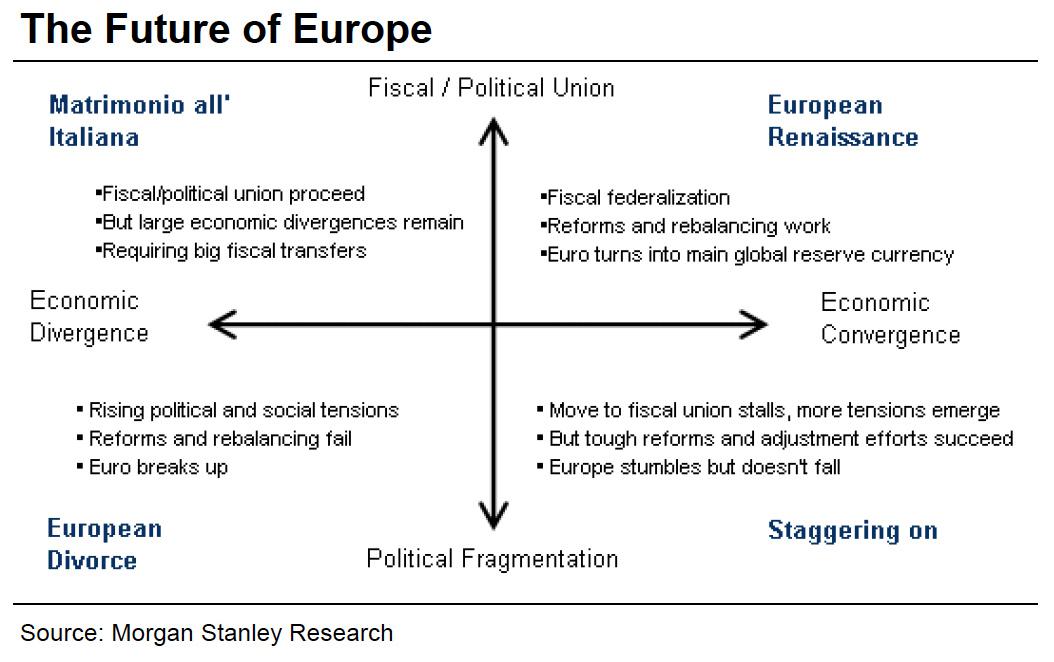
As you can see from the nice Morgan Stanley chart above, Europe is still very much in flux and we are still very much in cash but, as I noted in Friday morning's post - we are happy to be bullish in our very aggressive $25,000 portfolio which is an aggressive carve-out to a more conservative portfolio, like our virtual $500,000 income portfolio - the latest version of which we initiated last week with 10, count 'em, bullish trades last Monday and Tuesday - tagging the bottom (we hope) on the nose.
Providing our levels hold, we have no reason not to be bullish. Clearly the stimulus fairy is alive and well in Europe - Spain was not even given conditions for accepting the latest bail-out and they CLAIM that the only need $44Bn more in bond auctions to keep the lights on through the end of December - isn't that just great?
I am just bursting with sarcastic confidence for Spain and the rest of the EU because now the Spanish banks can buy the Spanish debt with EU money and we can pretend everything is good until next year - when the $125Bn runs out and we suddenly realize Spain is another 10% of their GDP in debt while the money that was lent to Spanish Banksters is all gone - leaving Spanish debt as collateral.
All we need is Jennifer Aniston and Jim Carrey cast in the leads and we have the makings of the next great romantic comedy movie.
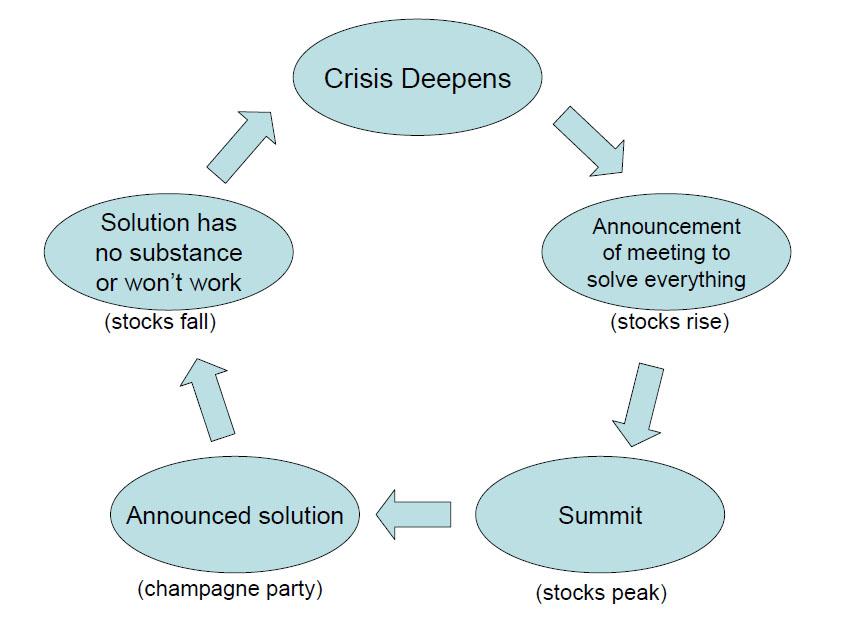
Just like Jim Carrey movies, people never get tired of celebrating these endless EU "fixes" but, just like Jim Carrey movies - once they are over, you have a Hell of a time trying to explain to someone else why it was funny. Jim Carrey and the EU have that certain "je ne sais quoi," which makes you smile for a second and forget your troubles but, at $15 a ticket and another $10 for a popcorn and soda - you still walk out feeling kind of screwed and just a little bit more broke - wishing you had just stayed home and waited for it to come on cable instead.
If Spain is Jim Carrey then Italy is Steve Carrell and, if that name makes you say "who," then congratulations - you have a life! The difference between Jim Carrey and Steve Carrell is that you also regret watching Steve Carrell on cable, but at least you weren't dumb enough to pay to see him in the movies. So far, we haven't been dumb enough to give Italy any money either but it's coming - I have no doubt.
Why bail out Spain if you're not going to bail out Italy and why Italy if not Portugal and why Portugal if not Ireland (again) and why do all those and then ignore France who, along with Germany, will be on the hook for all these bailouts when they start falling apart (which will happen as soon as we stop giving them more money)?
George Soros pointed out last week that EU authorities did not understand the nature of the euro crisis - they thought it is a fiscal problem while it is more of a banking problem and a problem of competitiveness. And they applied the wrong remedy: you cannot reduce the debt burden by shrinking the economy, only by growing your way out of it. The crisis is still growing because of a failure to understand the dynamics of social change; policy measures that could have worked at one point in time were no longer sufficient by the time they were applied. As this morning's market action indicates - we continue to put band-aids on bullet holes the global economy has suffered major trauma and our "leaders" are still worried about saving the blood transfusion for a rainy day.
In retrospect it is now clear that the main source of trouble is that the member states of the euro have surrendered to the European Central Bank their rights to create fiat money. They did not realize what that entails - and neither did the European authorities. When the euro was introduced the regulators allowed banks to buy unlimited amounts of government bonds without setting aside any equity capital, and the central bank accepted all government bonds at its discount window on equal terms. Commercial banks found it advantageous to accumulate the bonds of the weaker euro members in order to earn a few extra basis points.
Then came the crash of 2008 which created conditions that were far removed from those prescribed by the Maastricht Treaty. Many governments had to shift bank liabilities on to their own balance sheets and engage in massive deficit spending. These countries found themselves in the position of a third world country that had become heavily indebted in a currency that it did not control. Due to the divergence in economic performance Europe became divided between creditor and debtor countries.
It took some time for the financial markets to discover that government bonds which had been considered riskless are subject to speculative attack and may actually default; but when they did, risk premiums rose dramatically. This rendered commercial banks whose balance sheets were loaded with those bonds potentially insolvent. And that constituted the two main components of the problem confronting us today: a sovereign debt crisis and a banking crisis which are closely interlinked.
According to Soros: The authorities did not even understand the nature of the problem, let alone see a solution. So they tried to buy time. Usually that works. Financial panics subside and the authorities realize a profit on their intervention. But not this time because the financial problems were reinforced by a process of political disintegration. While the European Union was being created, the leadership was in the forefront of further integration. But after the outbreak of the financial crisis the authorities became wedded to preserving the status quo. This has forced all those who consider the status quo unsustainable or intolerable into an anti-European posture. That is the political dynamic that makes the disintegration of the European Union just as self-reinforcing as its creation has been.
Financial institutions are increasingly reordering their European exposure along national lines just in case the region splits apart. Banks give preference to shedding assets outside their national borders and risk managers try to match assets and liabilities within national borders rather than within the eurozone as a whole. The indirect effect of this asset-liability matching is to reinforce the deleveraging process and to reduce the availability of credit, particularly to the small and medium enterprises which are the main source of employment.
So the crisis is getting ever deeper. The real economy of the eurozone is declining while Germany is still booming. This means that the divergence is getting wider. The political and social dynamics are also working toward disintegration. Public opinion as expressed in recent election results is increasingly opposed to austerity and this trend is likely to grow until the policy is reversed. So something has to give.
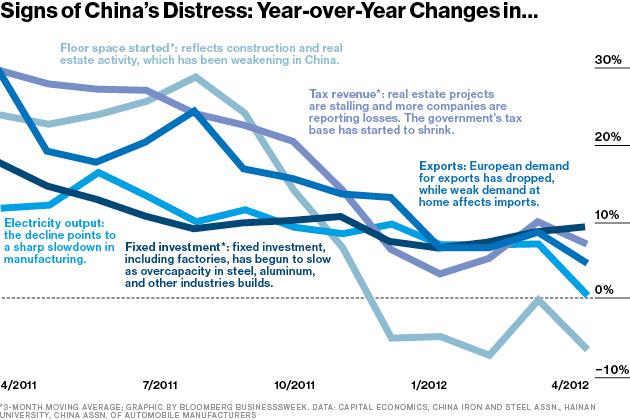
Soros gives the EU three months to either take DRASTIC action or it will fall apart through sheer inertia. Voting to keep it together won't help - that's like all the passengers on a plane voting to keep flying after all the engines have blown out - it might make them all feel better but they're still going to crash. The sold consolation for the EU is - at least they're not China:
(Click to enlarge)
On Friday morning, I said to members: "China's data is now expected to be bad so I'm less worried about that (also since it will say whatever they want it to say) than I am about Europe spinning out of control." As we expected, China's data came in better than expected this weekend and that will pretty up the chart above but only within the bounds of that horrific downtrend. The Hang Seng (Hong Kong) popped 2.5% this morning on that "good" news out of China but the Shanghai only rose 1%, to 288 on the Dow Index, which is still down 100 points (25%) since April 2011 but UP 13% from 252 this year.
Of course, PSW members will do the math and see that 388-252 = 136 and 40% of 136 is 54 plus 252 = 306 so that's our strong bounce and just so happens to be EXACTLY where the Shanghai was rejected last month - what a coincidence!
Our weak bounce line is 278 and that too was just about right on the money (274) on the retrace so we'll be watching China with great interest as it's stuck in the range between the strong and weak bounce but that rapidly falling 200 DMA and weakly converging 50 DMA is going to make 295 a very tough nut to crack.
Well, that's enough TA for the day - I'm already bored by it. Tomorrow is Technical Tuesday and we'll do some charts then but, for now - it's $10Bn per point on the S&P so, if you want more points, someone needs to come up with more money. G20 meeting is this weekend and then we have a Fed meeting. China already kicked in a few hundred billion but we need action in Europe, Japan and the U.S. now or it's going to be a very short-lived rally.
Spain's 10-year is 6.45% this morning - AFTER the bailout and Italy just broke 6% at 6.01% and both Spanish and Italian markets have given back almost all lf their early gains as people who know how to do math wake up and comment on the latest "fix" - and I use that in the most useless and temporary, junkie-applicable form of the word.
We had a nice pop - we were lucky to be bullish - CASH REMAINS KING.
Disclosure: I am long GOOGFASEWJTNA.
Additional disclosure: Positions as indicated but subject to rapid change - CASH IS KING.