Thursday, October 2, 2014

Hong Kong Leader Refuses to Resign, but Deputy Meets With Protesters

from nytimes

HONG KONG — As demonstrators massed outside his offices on Thursday night, Hong Kong’s embattled chief executive rejected demands that he resign and tried to ease public anger by assigning his deputy to meet with student protesters to discuss their calls for democratic reform.
But the chief executive, Leung Chun-ying, who was anointed by Beijing to lead Hong Kong two years ago, said the talks would have to be in accordance with an earlier ruling by the Chinese leadership limiting the scope of political change here — a ruling that has been a target of the mass protests that have shaken this former British colony for nearly a week.
“I will not resign because I have to continue my work on universal suffrage,” Mr. Leung said, referring to a proposal to allow residents of Hong Kong to elect his successor in 2017 from among a limited number of candidates approved by Beijing. He also defended the police’s handling of the protests, which included an attempt to disperse crowds using pepper spray and tear gas that infuriated residents.
Continue reading the main storyVideo
PLAY VIDEO

Voices of Hong Kong’s Protest

Hong Kong residents reflect on the recent days of protests.
Video by Jonah M. Kessel on Publish DateOctober 2, 2014. 
Hours later, one of the two main student groups behind the demonstrations, the Hong Kong Federation of Students, issued a statement agreeing to meet with Mr. Leung’s deputy, Chief Secretary Carrie Lam, but called for the talks to be held in public. It added that the protesters’ “occupation” of key parts of Hong Kong would continue, and that the outcome of the talks would determine whether they adopted more aggressive tactics.
Another protest group, Occupy Central, also welcomed the offer of talks but repeated demands that Mr. Leung step down and Beijing withdraw its ruling limiting political change.
Mr. Leung’s remarks, made at a late-night news conference, were greeted with skepticism by some of the protesters camped outside his offices.
“We think he’s playing for time to see which side can outlast the other,” said Tiffany Ko, a student at the Hong Kong Institute of Education. “The dialogue will not be a real dialogue — that’s clear already,” she added. “He’s just going around in circles.”
Several students took exception to Mr. Leung’s comment that the police had exercised maximum restraint. “We were just being peaceful, so why say we must be tolerated?” said one, Yan Chen-man. “That shows his thinking.”
Earlier in the day, the police carried containers of rubber bullets, tear gas and other riot control gear into the complex where Mr. Leung’s offices are, and organizers called on protesters to converge on the buildings, warning that the authorities could be preparing to clear the area to allow the government to reopen on Friday after a two-day holiday.
Tensions climbed as the crowd swelled. Some student leaders have called on protesters to surround and occupy government buildings if Mr. Leung does not step down. But the police warned that any attempt to do so would not be tolerated.
Several protesters said that while they would not storm the buildings, they intended to prevent Mr. Leung from entering his office on Friday morning. That set up a potential showdown with the government, which said that it had a “responsibility to protect these government offices so they can resume normal operation,” but stopped short of saying whether the police would try to drive the protesters away.
A Hong Kong official, who spoke on the condition of anonymity because of the political sensitivity of the subject, said the government was concerned about access to buildings, especially Police Headquarters, and wanted to warn the students not to defy police officers but could not do so easily because of limited communications.
Continue reading the main story

What Prompted the Hong Kong Protests?

Hong Kong belongs to China and operates under a policy of “one country, two systems.”
Prospects for reaching a compromise in the government’s talks with the students appeared limited. Mrs. Lam met in the evening with four pro-democracy lawmakers, and no progress was reported.
Faced with a government strategy to wait them out, the protesters, who have taken over key areas of Hong Kong for days, appeared unsure whether they should escalate their confrontation or begin searching for an exit strategy.
“We don’t have a leader,” said Irene Ng, an English major at Hong Kong Baptist University. “This is trying to be a democracy, but then you try to reach a decision and you can’t. Nobody can decide. The ultimate problem is it might split us apart.”
The protesters interviewed gave no indication that a retreat was imminent. But many wondered how long they could sustain the turnout necessary to block crucial roads in the city and just what would constitute an acceptable victory.
Tim Lam, an engineer who said he had joined the sit-ins every day since Sunday, said he expected the occupation to last another week at most. “That’s about how long the protesters’ passion can last,” he said. “After one, two weeks of occupation, protesters would start to think about how it affects the economy, the everyday lives of people.”
Further escalation by the protesters could alienate members of the public resentful of a demonstration that affects their daily lives. But without more aggressive steps, the protests could fade. “If we take rash actions, we may lose people’s sympathy,” said Niko Cheng, a recent college graduate and protester in Mong Kok, a densely populated area of Hong Kong on the Kowloon Peninsula. “But if this drags on — it’s already turning into a carnival, with people dancing, singing and all that — people may forget what they’re here for.”
Prominent voices in the pro-democracy campaign have indicated that there is no consensus on what, short of an unlikely reversal of the central government’s position, would lead to an end of the protests.

“We have to achieve something that will enable the crowd to claim victory,” said Albert Ho, a lawmaker. “They must retreat with dignity, but that may not necessarily be complete victory. There must be a sense of achievement.”
The Chinese Communist Party appeared to rule out any compromise on the protesters’ key demands, publishing a front-page commentary in its official newspaper, People’s Daily, that endorsed Mr. Leung and accused pro-democracy groups of threatening to drag Hong Kong into “chaos.” In a sign of its authority, the piece cited the senior leadership, including President Xi Jinping.
But many in Hong Kong shrugged off the commentary and said they would continue pressing for genuine elections. “All the protesters here and Hong Kong people know it is extremely unlikely the Chinese leaders will respond to our demands,” said Joseph Cheng Yu-shek, a political-science professor at the City University of Hong Kong and a longtime advocate of fuller democracy in the city. “We are here to say we are not going to give up, we will continue to fight on. We are here because as long as we fight on, at least we haven’t lost.”

Continue reading the main storySlide Show
SLIDE SHOW|9 Photos

Demonstrators Face Dilemma as Beijing Holds Firm

Demonstrators Face Dilemma as Beijing Holds Firm

CreditPaula Bronstein/Getty Images
Continue reading the main storyShare This Page

Wednesday, October 1, 2014

What toppled Lenin statues tell us about Ukraine’s crisis

from washingtonpost.com


 September 30  
In an incident reflecting growing Ukrainian anger toward the Kremlin, anti-Russian protesters pulled down a massive Vladimir Lenin statue in Ukraine's second-largest city late Sunday. To many Ukrainians, Lenin is a symbol of the Soviet Union and Russia's aggressive support for the separatist rebels in eastern Ukraine.
Despite the 1991 breakup of the Soviet Union which resulted in the split between Russia and Ukraine, hundreds of monuments to the founder of modern Russia survived the transition. Over the last months, however, many have been toppled: This map – based on accounts of activists -- shows the massive demolition of Ukrainian Lenin monuments in 2014 alone.
"To many Ukrainians, Lenin represents not only the communist regime, but also radical separation from Europe and Western civilization more broadly," Steven Fish, a Russian studies professor at University of California Berkeley, told the Los Angeles Times last December after a statue had been toppled in Kiev.
Other scholars view the toppling in a more modern light. Sasha Senderovich, assistant professor of Russian Studies at the University of Colorado Boulder who wrote a New York Times op-ed on this issue last December, considers Sunday's event not to be connected to Lenin specifically. "At this point, after Putin's assault on Ukraine's territorial integrity, the statue has become more symbolic of Russia's continued attempt to exercise imperial dominance over Ukraine rather than solely the historical legacy of the Soviet Union," he told The Post on Monday.
Kharkiv is considered one of the most vulnerable cities in the east if the pro-Russian rebellion were to spread. Previous attempts to pull down the statue failed because pro-Russian activists intervened, according to The Post's Michael Birnbaum.
These pictures show that Sunday's incident was clearly organized and must have been noticed. First, protesters cut the Lenin statue's legs.
Then, they pulled the statue down.
In fact, the recent toppling of the Lenin statue is just the latest in a series of attacks on hundreds of others that have been toppled in Ukraine over the last months as tensions with Russia have grown. Here is an alternative chronology of Ukraine's crisis, told through toppled Lenin statues.
A measurement of anger
Tearing down the iconic Lenin monuments rapidly gained momentum when it became clear that Ukrainian President Viktor Yanukovych had lost power over his country.
On Feb. 20, Kiev witnessed its worst day of violence in 70 years, with snipers targeting and killing protesters. On Feb. 22, Yanukovych disappeared, protesters stormed presidential buildings and opposition leader Yulia Tymoshenko was freed from jail. Data gathered by Ukrainian activists and visualized by The Washington Post show that more than 90 Lenin statues were toppled that day alone.

The activists uploaded pictures, dates and locations of the toppled statues on a platform called Leninopad and the individual contributions could not be independently verified.
How the 'statue war' spread
The visualizations below are based on the same data. Until Feb. 21 (the day before Yanukovych disappeared), the incidents appear to have largely been limited to the surrounding areas of Kiev where the pro-Western supporters had been in an overwhelming majority.
Then, however, the number of toppled Lenin statues quickly increased and spread throughout the country. The statues which were toppled earlier are shown in grey in the map below. It is important to note that not all defaced monuments in Crimea and the east are included in this map, because the activists did not provide a sufficient amount of date for some of them.
However, there appears to be a general lack of incidents both in the east (where the Ukrainian Russian speakers are predominantly located), as well as in the west. The latter observation is surprising because the western areas are the ones which are least supportive of Russia.
One possible explanation could be that Lenin statues in the west had been removed much earlier: Back in June 2009, pro-Western Ukrainian President Viktor Yushchenko had called upon his supporters to erase communist symbols from the country.
This map shows more recent incidents until August, but it is not clear whether the activists kept track of the toppling of Lenin statues during this time frame in the same manner as they did in February and March.
Our maps only include Lenin statues toppled in 2014. However, they have been a target for much longer, as part of a larger fight between pro-Russian activists and nationalists. Last August 2013, Russian news agency RIA Novosti specified that at least 12 Lenin statues had been pulled down or defaced since 2009, calling the incidents a "statue war."
According to The Atlantic, an advertisement video for the Euro 2012 soccer championships in Kharkiv erased a Lenin statue from a shot -- it appears to have been the very same statue which was pulled down Sunday evening and is unlikely to be the last such incident.
In a Facebook post, Ukraine's Interior Minister Arsen Avakov wrote on Monday: “Lenin? Let him fall down. As long as nobody suffers under his weight. As long as this bloody Communist idol does not take more victims with it when it goes."

Sunday, September 28, 2014

Schools and banks closed as Hong Kong paralysed by protest

from telegraph.co.uk


Monday morning saw surreal scenes in downtown Hong Kong as protesters continued to occupy main thoroughfares despite a night of tear gas battles with police

Protesters block the main street to the financial Central district outside the government headquarters in Hong Kong
Protesters block the main street to the financial Central district outside the government headquarters in Hong Kong Photo: Carlos Barria/Reuters
Schools were closed, banks were shuttered and bankers and lawyers were forced to take the subway as protesters chanting for democracy continued to occupy the centre of Hong Kong on Monday morning.
Riot police armed with tear gas and teams of officers armed with rifles failed to disperse a crowd of tens of thousands who began streaming into central Hong Kong on Sunday afternoon.
Instead, protesters camped overnight on Hong Kong island and in Kowloon, defying periodic tear gas and baton charges by the police and choosing to ignore rumours that the police would fire rubber bullets.
By the time of the morning rush hour, eight-lane highways were deserted and more than 200 bus routes had to be diverted or suspended. Although the number of protesters began to thin out as some went to work, it is likely that the crowd will swell again during the day.
One shopping centre near the government headquarters, the focus for the protests, flew its Chinese flag upside down in defiance. In Kowloon, protesters sang Cantonese rock anthems and chanted for the police to go on strike.
Hong Kong's school teachers union voted for a strike on Sunday, but those schools that did open on Monday saw student walk-outs.
The continuing chaos sent markets tumbling in Asia's financial capital, with the main Hang Seng index falling 1.73 per cent in its opening hour.
Anson Chan, Hong Kong's former second-in-command, said the scenes in central Hong Kong on Sunday night had disgraced the city. "This is a sad day," she said. "Pictures of our police force firing pepper spray and tear gas into the faces of unarmed protesters will shame our government in front of the whole world."
She said the current administration, by endorsing Beijing's plan to control the 2017 election for Hong Kong's mayor, known locally as the chief executive, had "paved the way for the current crisis".
The protests are the first major test for Xi Jinping, China's president, who came to power last year. On the mainland, censors worked to scrub any news of Hong Kong from reaching the Internet, while newspapers were told not to cover the story.
The Global Times, in its English language edition, continued to suggest that unrest in Hong Kong was being stirred up by foreign forces, saying that Western newspapers had seized on the protests and made comparisons with the Tiananmen Square demonstrations of 1989.
Regina Ip, Hong Kong's former security chief and a Beijing loyalist, told the South China Morning Post that the protest, which began with a student sit-in outside Hong Kong's government offices on Friday, had the potential to evolve into a "mini-Tiananmen".
"On the face of it, the students are voicing their demands for democracy and self-determination," Ms Ip said. "I think the worry on the part of the Hong Kong government is, what if it becomes a mini-Tiananmen? Who is behind it?"
She described the students, many of whom took part in Sunday's protests, as uncivilised. "They remind you of Tiananmen, the protesters asking for dialogue with the chief executive and surrounding the chief executive's office. If the police are driven to disperse them by force, it could turn sour and sinister," she said.
Sunday saw the angriest protests seen since Britain handed Hong Kong back to China in 1997, involving a reported 30,000 people.
The protests follow an angry summer in Hong Kong, with activists accusing the Chinese government of reneging on promises for a free election to choose the region's next mayor, locally known as the chief executive, in 2017.
China has promised universal suffrage – one person, one vote – but intends to control the selection of candidates.
A British parliamentary inquiry is under way, much to Beijing's irritation, into the proposed election plans and Richard Ottaway, the chairman of the Foreign Affairs Committee, has said China may have breached the terms of the handover.

Thursday, September 18, 2014

President Obama: ‘Americans Are United’ in Fight Against ISIS

from abc


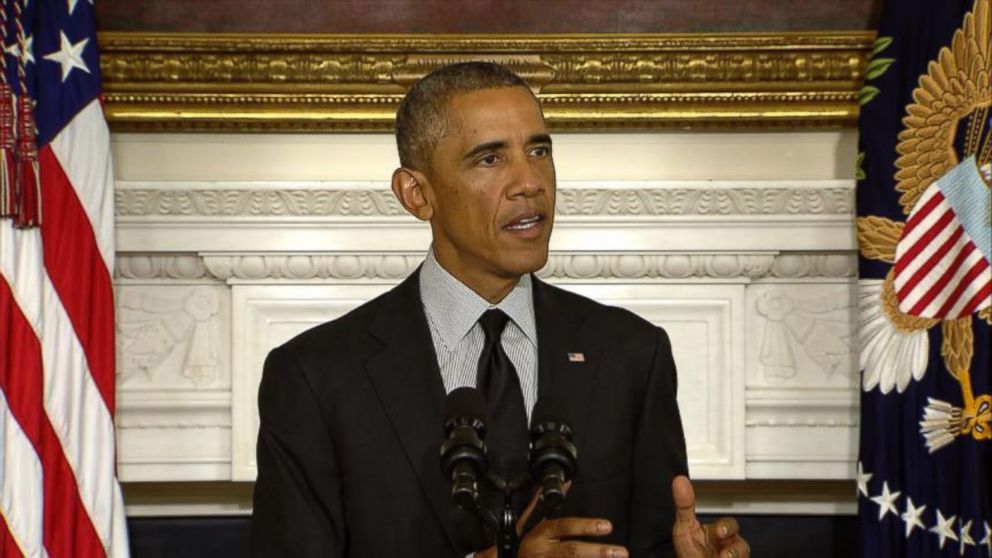
PHOTO: President Obama addresses the nation on Sept. 18, 2014.
The Senate passed a stop gap funding measure tonight, which includes authorization for President Obama's plan to train and arm Syrian moderates in the fight against ISIS.
The Senate voted 78-22 on the continuing resolution, which will fund the government and authorizes Title X until December 11.
Many Republicans joined Democrats in voting for the continuing resolution, making this a rare bipartisan showing in the Senate.
In a brief statement from the White House President Obama declared a united American front in the fight against ISIS militants.
“The strong bipartisan support in Congress for this new training effort shows the world that Americans are united,” Obama said. “I want to thank members of congress for the speed and seriousness with which they approached this urgent issue -- in keeping with the bipartisanship that is the hallmark of American foreign policy at its best.”
Obama called the program a “key element” of his strategy to combat ISIS, supporting non-American boots on the ground “so that they can help push back these terrorists.”
The president also hailed the growing international coalition of “more than 40 countries, including Arab nations” – singling out France, which announced today that it would join the U.S. in conducting airstrikes in Iraq.
Of the vote, Sen. John McCain, R-Ariz., said: “It’s a long overdue support for the brave Syrians who are fighting on the front lines against the terrorist enemy."
“There is no guarantee of success. ... There is none but there is a guarantee of failure if we do not even try and try we must,” Sen. Marco Rubio, R-Fla., said of arming and training Syrian fighters against ISIS. “Despite my concerns about the underlying bill…I will support this resolution because I think it’s in the best interest of our national security.”
But several of the president’s biggest allies, including one with a tough re-election fight this November, voted against the measure.
Sen. Mark Begich, D-Alaska, whose Republican opponent in the Alaska Senate race said he would support the president’s plan to arm the Syrian rebels, voted against the continuing resolution due to his opposition to training and arming the Syrian rebels.
“I disagree with my president,” Begich said. “The rebels of today may not be the rebels of tomorrow.”
Unlike the House of Representatives, the Senate did not hold a stand-alone vote on the bill, many argued due to concerns of how it would play in the midterm elections this November.
The House had approved authorization to train and arm the Syrian rebels with a vote of 273 to 156 on Wednesday.
The authorization for training and arming the Syrian rebels will run out on December 11th, at which point Congress will have to decide whether it will reauthorize the plan. Sen Dick Durbin, D-Ill., indicated that the Senate will consider a new authorization for the use of military force in November when Congress returns for the lame duck session.
“We are going to take up the construction of a new authorization for the use of military force,” Durbin said. “It’s long overdue. We are living on borrowed time and we’re traveling on vapors. AUMFs passed in 2001 and 2002 are hard to wrap around today’s challenge.”
The continuing resolution now heads to the White House for President Obama’s signature and gives the president the green light to move forward with his plan to train and arm the Syrian rebels.
In his statement Obama reiterated the pledge he made yesterday at CENTCOM: “American forces deployed to Iraq do not and will not have a combat missions. Their purpose is to advise on the ground,” he said.
Meanwhile, the Pentagon is preparing to expand American airstrikes into Syria, which administration officials have said could come any day.
Obama acknowledged tonight that U.S. pilots will be at risk on those missions. “We salute our dedicated pilots and crews,” Obama said, “who are carrying out these missions with great courage and skill.”
He asked Americans to “to keep our forces and their families in their thoughts and prayers.”